Monday, November 26, 2018

My Unforgettable Trip to the Great Barrier Reef and Daintree Rainforest, Australia


It was my childhood dream to visit the living wonder on earth and was fulfilled when our son had planned our weeklong trip to the Great Barrier Reef near Cairns, Australia when I visited him with my husband in May 2015.

During this adventure, we went through different weather conditions and different terrains and vegetations and also on different modes of transportation to enjoy nature's gift.

Our trip started with a three-hour flight from Sydney to Cairns and upon exiting the plane in Cairns, we realised the contrast in weather between Cairns and Sydney.

Sydney was in its wintertime whereas, in Cairns, we experienced a very warm weather. Cairns.
is a city in the Cairns Region of Queensland and is on the east coast of Far North Queensland.

We chose two iconic world heritage areas as our tour package (dual package)---the majestic Great Barrier Reef (GBR) and the ancient rainforest Daintree. They both exist side by side forming one of the most diverse ecosystems on earth.


Both GBR and the Daintree Rainforest exist side by side forming one of the most diverse ecosystems on earth. 


We took a flight to Cairns on May 7 as Cairns is the gateway to the Great Barrier Reef (GBR) as well as the Daintree rainforest.

Skipping the Cairns city, from the airport we went straight to Port Douglas and reached our guest house in the afternoon. It was very warm and humid. After resting for sometime, we explored the place for some eateries and also bought hats and other required items for the trip.

Next day on May 8, we began our journey in the Pacific Ocean from Port Douglas to Agincourt Reef which is at the very outer edge of the GBR. At this place, we saw a special reef known as 'Ribbons' and they were parallel to the continental shelf.


Entering the GBR was an extraordinary experience. It was a thrilling moment of sharing the wonder of the world's largest living entity, realising its breathtaking colour and majesty.  Seeing nature closely at its most perfect is an awakening and lifetime memory.

One can see swaying reefs with colourful fishes, big and small dancing away in and around them. Sea Anemone, starfishes are other attractions of the reef beside varieties of multi-coloured corals.

This is the place where there is a man-made permanent station, Quick Silver', with all facilities like modern and spacious activity platform---largest on the GBR. Our ferry reached and docked alongside this permanent station and we were shifted to the activity platform.


From this platform, we experienced the most pristine ecosystem at the well known Agincourt Ribbon Reefs. The activities of the day on the platform included Reef presentation by marine biologists, observation of corals and fishes with snorkelling, semi-submersible vessels and an aerial view of the reef from a helicopter.

My son chose to snorkel to observe the corals and the pristine marine ecosystem, while I chose an aerial view of one of the great wonders of the world and took a helicopter. Later my son and husband joined me and boarded a semi-submersible vessel to observe the corals in close quarters through the glass window.


Clean water provided the best possible underwater visibility. It also encourages rich coral growth and supports spectacular marine life.

A ten-minute helicopter ride above the GBR was a lifetime experience and was spectacular and cannot be described in words. the view from the helicopter included the pictures showing the vast coral formation, marine life, opal blue reef lagoons and the kaleidoscope of patterns at the reef's outer edge.


The close-up view of the corals of the GBR from the semi-submersible was stunning and we three enjoyed it thoroughly. The semi-Submersible was like a mini-submarine and there were seats close to each other and had to get in and get out one by one. Below are some of the pictures we took of the corals and sponges from the semi-submersible from different locations.


The dual package we opted in this trip made us realise how the world's oldest tropical forest providing rich nutrients to the GBR carried through the Daintree River, Thus we witnessed a sustained ecosystem in the Pacific Ocean.

After the underwater experience, we visited the Wildlife Habitat in Port Douglas. It is a care centre and serves the community to provide assistance to sick and orphaned and injured wild animals. The Centre takes care of wide range of species of Port Douglas including crocodiles, platypus and plethora of bird species.


Next day, May 9, we prepared ourselves to enjoy another world heritage----the spectacular wet tropics Queensland. From Port Douglas, we travelled around 46 km and came to the Daintree Rainforests.

The Rainforests of Daintree and Cape Tribulation are in the wet tropics of the Southern Hemisphere region and among the most important on earth, having survived over 150 million years of climate change, according to biologists here. One of the largest rainforest wilderness in Australia centres on the Daintree River valley.

A Daintree cruise or 'CrocodileExpress' took us through the Daintree River. The 140 km long river has 50 per cent salinity, according to local experts. We had the opportunity to have both Upper and Lower Daintree cruise trips.


Our trip on Crocodile Express departed near Daintree ferry crossing and went through the saltwater section of the river (tidal zone), saltwater crocodile habitat and magnificent mangrove forest housing a number of birds, butterflies and other creatures. We also could view Thornton Peak.

We sat back in the cruise and enjoyed the tranquillity of nature around us. We witnessed the most beautiful mangroves, varieties of birds and butterflies.

The pictures below will take you along the Daintree River with thick rainforests on both the sides and rich mangrove vegetation.


Beautiful Mangrove vegetation along the banks of the Daintree River


Other types of vegetation of the rainforest


We were also lucky to spot a large crocodile resting on the river bank, camouflaged with the background. Biologists here said that there were more than 80 very large crocodiles in the river.


Later we went to Cape Tribulation, which was further north of Daintree rainforest. We crossed the Daintree River on one of the last remaining cable car ferries in Australia. It could accommodate up to four cars.


Next day on May 10, we went to Daintree Discovery Centre which provided us with an excellent
introduction to this ancient pocket of rainforest. We could be in the midst of the rainforest----an apt ecotourism.

With an 'Advanced EcoTourism' accreditation, the centre seemed to be widely recognised as a leader with its state of the art audio guides, allowed its visitors of all ages an easy access to this unique wilderness.


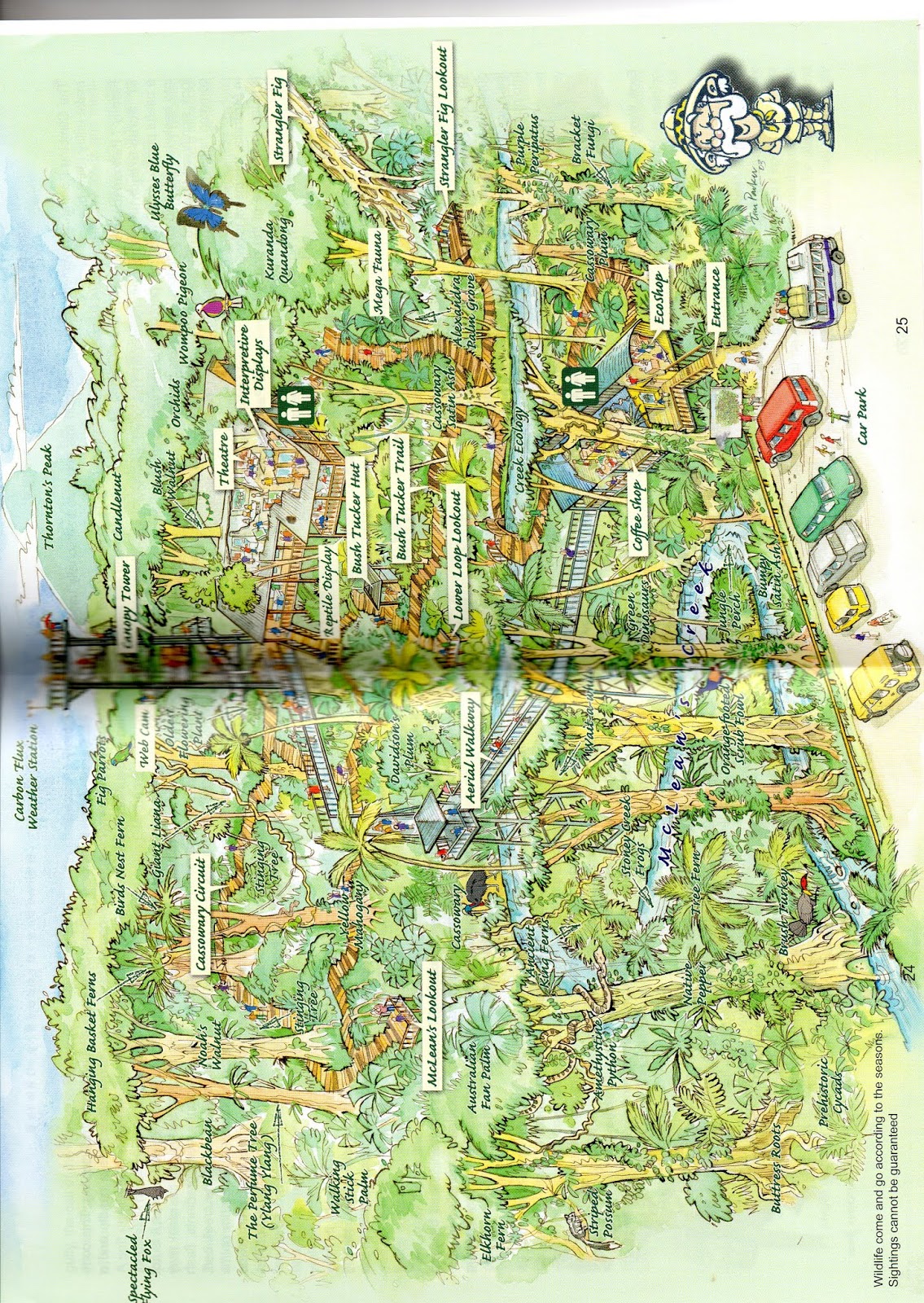
The aerial walkway is spectacular and is wheelchair friendly. It allowed safe and easy access to the mid-level rainforest. It connected the reception desk of the centre and coffee shops with Canopy Tower, the cassowary Circuit, Bush Tucker Trail and interpretive Display Centre.

Canopy Tower provided an amazing insight into the surrounding rainforest----from the forest floor to the canopy.


The facilities there were unique which never allowed any tourist to disturb the forest in any way. There is also a carbon flux weather station as part of the preservation of the green ecosystem.

Interpretive display centre had an interactive technology on a range of topics including Evolution, fungi and other flora and fauna.

There was a reptile display both featuring with local pythons and water dragons. We also went through elevated boardwalk.


Audio guides were interesting features of this trip. They were like having an individual personal tour guide and were available in eight languages in 2015.


Following is the schematic diagram of the Centre as provided by the officials for the tourists.


Coming back to the facts on the Great Barrier Reef (GBR), it is a breathtaking spread of intense colours covering an area of 348,700 sq km is actually not one reef but a collection of numerous coral reefs and islands. It is the largest such system in the world, biologists said.

The GBR dates back to the last Ice Age when the current Continental Shelf was exposed. When the sea level rose, barrier islands, dunes and all other beaches were submerged, thus created a perfect platform for the reef colonies---the tiny organisms that build coral.

According to scientists, when the sea level fell, exposed coral broke off and this reef debris raised the level of the shelf floor in the reef zone, enabling more reefs to be built.

Currently, the GBR extends to a total distance of about 1250 nautical miles from near the mouth of the Fly River in Papua Guinea, down the Queensland coast to Lady Elliot Island off the coast of Bundaberg. The GBR is the only living thing that can be seen from the moon, some scientists claimed.


At present, the GBR houses about 350 species of coral, around 10,000 species of sponges, more than 4000 species of molluscs, 150 species of echinoderms and more than 1500 species of fishes, according to marine biologists.

The Cairns Region of the GBR is widely regarded as providing the best opportunities for reef viewing. this is because, in the Cairns region, the outer reef is much closer to the coast and the water depth is much less. The credit for preserving this nature's wonders fully goes to the Australian government.

According to our tour guide, diving and GBR go hand in hand. Even those who have done diving before, enrol themselves in a diving course as soon as they arrive in Cairns.

The GBR has some of the most colourful and diverse tropical reefs of the world. The water here is warm and relatively safe. Although people who come for a few hours prefer snorkelling to observe
corals, diving (scuba) gives the advantage of being able to live in and be a part of the (albeit briefly)
this amazing underwater world, the excited tour guides told us.

On some more facts about Daintree ---it is one of the few places in the world where the rainforest meets the reef, thus providing nutrients to the reef. Daintree Rainforest is a living museum of flora and fauna and in its antiquity, it is the oldest intact low land tropical forest in the world----around 110 to 220 million years old, tens of millions of years older to the Amazon rainforest of South America, experts in the field said.

Then we spent two days at Cairns city before leaving for Sydney where my son used to live.

In conclusion, I would like to say that in this ecotourism, the discipline observed in GBR
as well as in Daintree rainforest has to be appreciated as the authorities there not only help protect nature's balance but teach us how to live in harmony with nature practically.


By
Lalitha Vaidyanathan,
Mumbai, India


Saturday, April 7, 2018

My visit to Australia's Kiama Blowhole and Stanwell Beach Park

It was between  December and January 2015/ 2016, I came down to Sydney, Australia from Mumbai, India with my husband to celebrate the engagement of my son Vivek to Anita.
After the engagement celebrations, we still had 15 days to have fun with our son and so we decided to help Anita and him scope out wedding and reception venues for November 2016 in Sydney before we leave for India. After a few days of intense search, we realized that Sydney was a notoriously difficult place to find a good wedding venue for Indian style wedding ceremonies. So we decided to use our limited time to relax and visit tourist places around Sydney.
Vivek and Anita later found a beautiful venue in a place called Toowoomba near Brisbane, Queensland, as their wedding destination. 
So we went on to visit  Kiama Blowhole and  Stanwell Beach which are important tourist spots near Sydney.
On the way to Kiama and near Stanwell Beach we spotted the stunning and famous Sea Cliff Bridge and my son drove on the bridge. It was a beautiful experience and a great scenic drive. 


The Kiama Blowhole is one of the largest blowholes in the world is located in the town of Kiama in NSW. It is the town's major tourist attraction. It is Kiama’s major tourist attraction. It is estimated that this blowhole attracts over 600,000 people per year. People come to view the spectacular plumes of water that can be seen when the seas are running from the southeast.
,


During high tide, the blowhole can spray water up to 25 metres (82 ft) in the air, in quantities that can drench bystanders. A viewing platform with disabled access gives good views of the Kiama blowhole.


Some of the boards display what is Blowhole and how it works

There is a second, less famous blowhole in Kiama, commonly referred to as the "Little Blowhole" by locals. It is much smaller due to its narrow shape, it is more reliable than the Big Blowhole, and in the right conditions can be equally spectacular, according to some friends who had visited the site earlier in the year.
The "little blowhole" is located at the Little Blowhole Reserve, Tingira Crescent, a few minutes drive south of the main blowhole. This landmark has attracted people to the region for more than 100 years. It was first sighted by George Bass when he anchored his whaleboat in the sheltered bay in December 1797, now known as Kiama harbour.

After visiting the main blowhole, on the way back to Sydney, we went to the famous Stanwell Beach Stanwell Park Beach. This pristine location at Stanwell Beach looked ideal for families with a large area for picnics and is located right on the beach. This is located 26 kilometres north of the Wollongong central business district.
This beach is also famous for its hang-gliders and para-gliders and we had an opportunity to photograph them preparing for action. Unfortunately, on that day the wind did not cooperate for me to photograph the gliders soaring above the cliffs and the Pacific Ocean.


Made famous by Australian Aeronautical pioneer Lawrence Hargrave, Stanwell Park Beach is where Lawrence first flew his box kite on November 12,1894. Today, this picturesque village on the northern tip of Woologong is an internationally acclaimed area for hang-gliding and paragliding.
Famous in world aviation history, Stanwell Park is where Australian aeronautical pioneer Lawrence Hargrave first flew in his box kite on 12 November 1894. Today, this picturesque village on the northern tip of  Wollongong is an internationally acclaimed area for hang-gliding and paragliding. Then we relaxed on the sandy beach for an hour.
By Lalitha Vaidyanathan

Saturday, February 10, 2018

Our village deities

Our Village deities


Visiting Village deities is always a ritual and especially before any auspicious occasion in the family, the South Indian families are particular in seeking the deities blessings.

Our village deities are not very famous and therefore I decided to write a blog on them.

They are located in Pachur, not a very well known a small village/hamlet in Manachanellur Block in Tiruchirappalli (Trichy) district in Tamil Nadu. It comes under Kovathangudi Panchayat and is 12 km towards north from Trichy, seven km from Manachanellur. From Chennai, it is about 345 km.

In Pachur, the village deities include Sapta Kannigargal (seven female deities), and the village protectors  Karuppusamy (also called Chappani, a formless one) and Ayyanar. They are located on the outskirts of the village and we have to cross a canal (which is branched out of the Kollidam river) by foot.

                                         The canal for irrigation diverted from Kollidam river


For the worship of Sapta kannigai  (or Seven female deities or virgin mothers) namely Brameshwari, Maheshwari, Vaishnavi, Koumari, Varahi, Indrani and Chamundi,  we had bought a red coloured saree.

They are placed in a small temple along with Lord Ganesha (on the side) and looked after by a local non-brahmin priest and I was touched by his devotion and simplicity.

A village woman washing her cattle in the canal

This is the Saptakannagai temple from outside

Steps leading to the temple and on its left are the statues of protectors


The dark door in front is where the deities are placed


The priest doing aarthi

                                     Ganesh idol is seen on the right side of the Sapta kannigai

The worship pattern is non-agamic. The deities are offered all kinds of flowers, Banana and coconuts after draping the new red coloured saree on all the seven deities.

There is no electricity inside the temple and only through an oil lamp burning, we could see the deities. surrounding this temple there are statues of protectors with Aurval in their hands.


Few yards from this temple, in an open space, we went to worship Karuppusami or Karuppanar, village protector. Karuppu means black in Tamil.

Karuppannar worship, I was told, is a very ancient clan-based system and priests are non-brahmins and derive from local lineages that had initiated the system. The maintenance of the temple is taken care of the whole village.

Karuppusamy is also called as Chappani (picture below) in Pachur which is a formless stone and is decorated with clothes and flowers.Surrounding this deity are few erected tridents, symbolising protection and devotees pierce lemons on these tridents.


No typical temple structure or gopurams for this deity. The worship pattern here is also is non-Vedic or non-agamic. That is it done through folk tales/songs.


Nowadays, the local priest MrChinnappa (who died recently) had told me that a lot of natives settled in different parts of the country come here and help in revamping the place and help the priest.

In the same premises, there is a big colourful statue of Ayyanar on a horse. He is primarily worshipped as one of the guardian folk deities. Here Ayyanar is flanked by his companions riding horses and elephants
                                      Priest late Mr Chinnappa standing near the Ayyanar's horse


.


                                                                                    By Lalitha Vaidyanathan


Monday, June 10, 2013

Bats in Mumbai

Need to secure bats under a new law of wildlife protection for their role in the environment


When I was a child, I used to visit Chidambaram for summer vacations where my maternal grandparents and uncle used to stay. It used to be a meeting place for all the cousins. Every morning and evening we used to visit the great Nataraja (dancing Shiva)  Temple of Chidambaram and at all the four entrances (Kopurams), I used to see bats (the flying mammal) sitting during the daytime in the inner portions of Kopurams and crevices (where there was no sunlight) and in the evenings (during and after sunset) moving very fast in large numbers in the same temple premises. Being nocturnal, I used to wonder from where they will get their food!!

I used to get scared that they might attack us. But nothing happened. They were tactfully managing their movements without hitting anyone or hurting themselves!! I used to be amazed by their behavior. Similarly, I have seen bats in many of the old buildings and temples in south India.
But as years passed , time took me to various cities where I did not get time to go deep into the behavior of bats.

When I retired from my 25 years of hectic job recently, I found time for long walks in the evenings or mornings in the city of Mumbai where I reside. 

As part of my walking sessions to various destinations within Mumbai, I go to Five Gardens, near Parsee Colony in Central Mumbai at least four times a month.

One evening in May 2013, I saw a colony of bats hanging and some flying away and coming back to the trees to hang at least on two or three trees in the `Five Gardens’ area in Central Mumbai in large numbers. These bats are also called `day roosting flying foxes.

 
Roosting flying fox colony (bats) on trees at the `Five Gardens' area
May 27, 2013

 
Roosting flying fox colony (bats) on trees at the `Five Gardens' area
May 27,2013
 
                         A single roosting flying fox was seen hanging from a tree at the `Five Gardens' area
                                                                May 27, 2013

I was surprised to see them in such a busy place where there is heavy traffic. I have read in books that bats are seen in the villages on top of fruit trees and inside some of the old temples and buildings.

Then I spoke to the director of the  Bombay Natural History Society (BNHS) Dr Asad Rehmani about my spotting of the flying fox colony at Five Gardens,  but he was not surprised and he said “you can find them roosting in trees just outside the BNHS which is located  in the busiest area of  South Mumbai with heavy traffic  and also in some other parts of Mumbai.”

One of my photographer friends told me that he even found a big and very noisy colony of flying foxes near one of the newspaper offices located in Mahim in North Mumbai. Rehmani also said they keep changing their roosting location depending on the availability of food. One more roosting place is located in Mulund  West --- in one of the busiest linking roads of Mumbai!

                                           A flying fox in the `Five Gardens' area duirng dust
                                                                     June 7, 2013


                                         A flying fox in the `Five Gardens' area during dust
                                                                   June 7, 2013

                                        
                                         A flying fox hanging upside down on a tree at `Five Gardens'
                                                                    June 7,2013
                                                      

I was excited about the whole thing and was keen to know more about bats of India. 

While searching the literature, I found that  Dr Prof G Agoramoorthy, Distinguished Research Professor at Tajen University, Taiwan had done some detailed studies on Indian Salim Ali’s fruit bat Latidens salimalii and studied them in Megamalai forest of the Western Ghats in India some time ago ( Salim Ali’s fruit bat finds an entry in the Guinness Book as one of the three rarest bats in the world).

He told me in an email interaction that  India is home to about a hundred species of bats, including 12 fruit bats, such as the fulvous fruit bat Rousettus leschenaulti, Indian flying fox Pteropus giganteus, Nicobar flying fox P faunulus, island flying fox P hypomelanus, Blyth’s flying fox P melanotus, short-nosed fruit bat Cynopterus sphinx, lesser dog-faced fruit bat C brachyotis,  Ratanaworabhan’s  fruit bat Megaerops niphanae,  Salim Ali’s fruit bat Latidens salimalii, Blanford’s fruit bat Sphaerias blanfordi, dawn bat Eonycteris spelaea, and hill long-tongued fruit bat Macroglossus sobrinus.

“Sadly, though, data on the conservation status, population density, and ecology of many of these species is limited due to lack of field studies,” he said.

The bats in general are often ignored by the public and the Hindu religion has somehow missed out to name them as Gods/Goddesses!!!!,Agoramoorthy  said.

Agoramoorthy also said the Indian Wildlife Protection Act of 1972 consigned bats to schedule V  along with the common crow, mice, and rats. This means that the animal is deemed to be ‘vermin’ and is devoid of any protection. Therefore, hunting a fruit bat and other bats is not a crime, according to the Act.

“ While the more glamorous animals — elephants, rhinos, lions, and tigers — have received considerable attention from conservationists in the country, bats have been largely ignored in such discourses,” he said.

Joseph Reginald Louis of SACON ( The Sálim Ali Centre for Ornithology and Natural History)  who is studying fruit bats had said recently that he was fascinated by them. Fruit bats, with their big eyes and pointed snouts, look cute, he says. “I would call them nocturnal angels as they have a lot of “ecological impact.---- contribute a great deal to pollination and seed dispersal.

Despite the efforts made by academicians to get fruit bats off Schedule V, the Ministry of Environment and Forests has remained unresponsive according to  Dr. G. Marimuthu, Head, Department of Animal Behaviour, Madurai Kamaraj University. His study on bats has shown that birds cause more damage to fruits such as grapes during the day than bats do at night. Marimuthu has spent 35 years of his life researching bats.

He pointed out that a  guava seed gets to travel long distances if the fruit is eaten by a bat. The seed, released in a new place with the excreta, has more chances of developing into a healthy tree than normal seed. “A seed that passes through the stomach of a bat has a better rate of germination,” he says.

Insect bats keep mosquitoes under control. “An insect bat that weighs two grams can eat up to 300 mosquitoes in an hour,” explains Sanjay Molur, Executive Director, Zoo Outreach Organisation. This way, bats directly contribute to keeping dengue at bay.

Despite their contributions to the environment, bats have more enemies than friends. Joseph feels that man is their biggest threat. Man hunts the animal for meat. “In Pollachi, a man has made hunting bats his occupation. He is known as ‘Vavval pudikkiravan’ (bat-catcher) in the area,” says Joseph.

Hunting and destruction of habitat have further threatened certain bat species. Joseph has observed a colony of them in Coimbatore that was forced to move since their home, a tree, was destroyed. The colony has changed four roosting sites already.

So when I asked Rehmani, the director of BNHS why the institute is not putting up boards under the roosting trees for the bat's protection, he said, “this will create more problems for bats than doing good and it is better that we leave them alone for their survival.”

Bats are the only mammals capable of true flight and around the globe there are 950 species of bats. One of the oldest fossils, Icaronycteris, is from the early Eocene era, dating back at least 50 million years. And this fossil hardly differs from the modern bat!

“These fascinating creatures of the night belong to the order Chiroptera, meaning ‘hand-wing’. Chiroptera has two suborders, Megachiroptera and Microchiroptera with 17 families and 177 genera,” Agoramoorthy said.

Bats belonging to the suborder Microchiroptera are the microbats or insect-eating bats. They have small eyes and large ears, and produce ultrasound over 15 kHz, which human ears are unable to catch. They rely on echolocation for navigation and to catch insects.

The suborder Megachiroptera consists of  the mega bats  or fruit-eating bats. These bats have large, keen eyes, an acute sense of smell and small ears as compared to the size of their bodies. In general, Megachiroptera do not produce ultrasound; however, those belonging to the genus Rousettus have a primitive echolocation system. They make an audible clicking sound through their mouths.

Tropical fruit bats play a significant role in rainforest ecosystems. Pollination of flowers, and dispersal of seeds of trees, shrubs, and climbers are all part of their function in the ecosystem. Besides, bat droppings in the caves they occupy support a delicate ecosystem composed of unusual organisms.

Agoramoorthy  said, day roosting colonies of the Indian flying fox are often located in the temporary safety of sacred groves of the slowest reproducing mammals of their size — bats produce one young a year — bats are extremely vulnerable to extinction. “That these gentle, beneficial creatures have been widely misunderstood and neglected further adds to the danger,” he added., germination, insect bat, 

With no protected natural forests suitable to sustain them, a large number of the flying fox colonies are located in unprotected agricultural land in villages. The flying fox prefers to roost in large Ficus benghalensis trees, which are located in sacred groves, and protected by the villagers.

“However, the very same bats become a fair game when once they leave their roost to forage for food. Within a mere two months, I saw hunters selling 46 bats in the local markets,”  he said.

His study showed that hunting is beginning to take its toll on one of the largest bats in India. If this unscrupulous hunting continues, these intriguing bats will become locally extinct in many villages.

There are widely reported instances of the drastic decline in population, even extinction, of certain species of fruit bats, due to hunting in Southeast Asia and the Pacific Islands.

Bat research in India has a lot of unexplored realms. “How far does a bat travel per day? What are its foraging patterns? We are yet to find out,” says Joseph.

 
A video showing the `flying fox' flying around the trees during sunset
 
 
On the question of why do bats hang upside down? “It’s part of evolution. It saves energy since they are not positioned against the force of gravity. Besides, the posture helps in easy takeoff.”

Let us try to learn more and more about this nocturnal hanging mammal and secure them under a new law of wildlife protection (yet to be created)!!!!!!!!!


P S: In the last couple of years when I drove through Mumbai, I found bats in many suburbs including in Chembur where I live. I also learned that bats have been living in the suburbs for a very long time. So enjoy watching bats in the financial capital of India. 


Lalitha Vaidyanathan

(also photos and videos by Lalitha Vaidyanathan)